
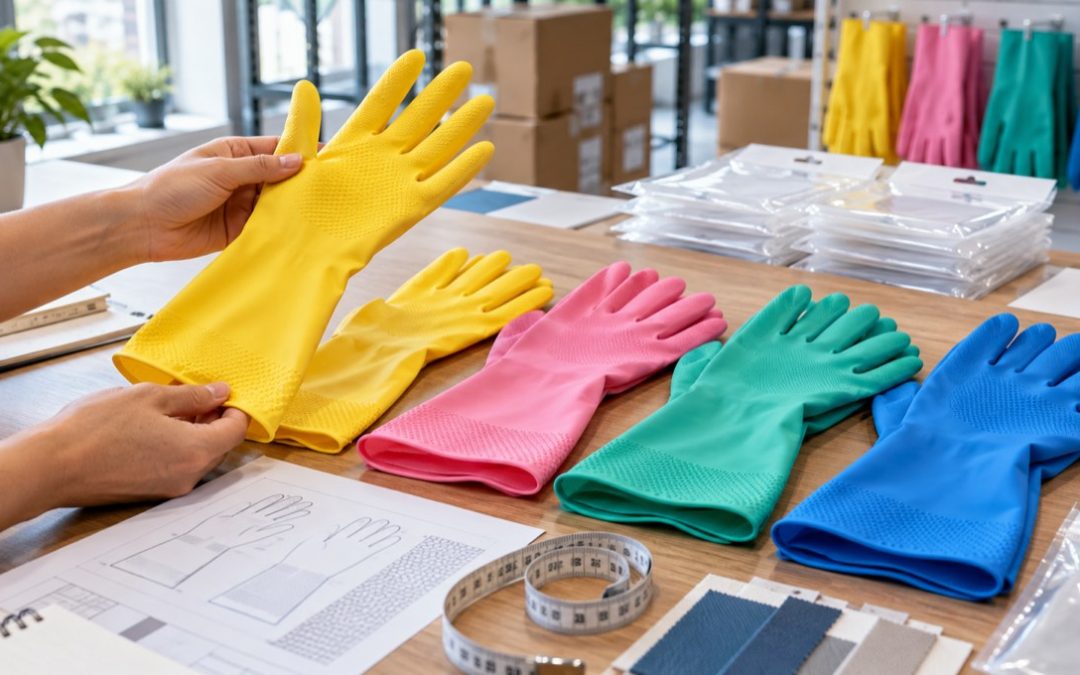
For a buyer starting a household cleaning glove range, the difficult part is rarely finding a yellow glove.
The difficult part is deciding what should be inside the range: which weights to offer, whether lining matters, how many colours are useful, what packaging fits the channel, and how to avoid ordering cartons that take up more space than they need to.
That is where a household rubber glove manufacturer should be more than a quotation source. The supplier should help the buyer turn a broad product idea into a workable range.
Start with the shelf or customer you are supplying
Household gloves are sold through very different channels. A supermarket may need bright colours, clear retail packaging and an easy size offer. A wholesaler may prefer a practical bulk-packed glove with fewer packaging components. A cleaning-supply distributor may need several weight options for different customer budgets.
Before choosing a model, decide:
- Who will buy the glove?
- Is it intended for retail, wholesale, cleaning distributors or private-label customers?
- Will it be sold as a single pair, multipack or bulk pack?
- Does the range need an entry-level product, a premium option, or both?
- Which sizes will be stocked in the first order?
These questions shape the right glove specification far more than a request for the “lowest price.”
What should buyers compare in household gloves?
Two household gloves may look similar in a product photo but feel very different when used.
When reviewing samples, buyers should compare the practical details:
- Glove weight and thickness
- Overall length and cuff coverage
- Flock-lined or unlined interior
- Palm and fingertip grip texture
- Colour consistency
- Fit across S, M, L and XL sizes
- Ease of putting the glove on and taking it off
- Retail appearance once packed
For example, a lighter glove may suit a value-focused retail line, while a heavier flock-lined version may work better as a premium household-cleaning option. Neither is automatically the right choice; they serve different customers and price positions.
View Canton Glove’s household cleaning glove range.
Why do lining and weight matter to the customer?
Buyers sometimes focus on colour first because colour is easy to see in a catalogue. But lining and weight often have a greater effect on the customer’s experience.
A flock-lined household glove can provide a different wearing experience from an unlined model. Weight can affect how substantial the glove feels, how it sits on the hand and how the product is positioned at retail.
The right approach is to request samples in the models being compared, then decide which one fits the intended retail position.
For a new private-label household glove programme, it is usually better to begin with a focused selection than too many similar models. One standard household glove and one upgraded option can create a clearer range than five products with only small differences.
How many colours should a private-label range include?
Colour is useful when it supports a clear commercial purpose.
Some buyers choose a single strong colour for brand recognition. Others use colour to separate product weights, retail collections or cleaning areas. A multi-colour assortment can work well, but only when the packaging remains easy to understand.
Before confirming colours, ask the supplier:
- Which colours are available for the selected glove model?
- Is there a colour requirement or reference that needs approval?
- Will colours be packed separately or as an assortment?
- Does each colour require a separate MOQ?
- Will the retail packaging change by colour?
This avoids a common issue: a buyer approves packaging for a colour assortment, then discovers that the carton split does not match the planned retail mix.
What should a buyer request before placing a bulk order?
Before placing the first order with a household glove supplier, request more than product photographs.
A practical checklist includes:
- Samples by model, size and colour
- Weight, length and size specifications
- Lining and grip details
- Retail packaging options
- Master-carton dimensions and gross weight
- Pairs or packs per carton
- Container loading estimate
- MOQ for the selected glove and packaging format
- Production timing after sample and artwork approval
- Documentation relevant to the selected product and target market
A clear enquiry saves time. Instead of asking for a general household glove quotation, give the supplier a usable starting point:
“We are building a private-label household cleaning glove range for retail. We need two glove weights, sizes S to XL, three colours, retail polybag packaging and a container-load quotation.”
That allows the supplier to recommend a suitable model and quote the same specification you intend to buy.
Why does carton planning affect your final cost?
Carton configuration is often treated as a packing detail. For an importer, it is part of the product cost.
The number of pairs per carton, retail-pack arrangement, carton dimensions and container loading quantity all affect freight efficiency. A lower FOB price can lose its advantage if the carton configuration leaves too much unused container space.
Before confirming volume, ask for the full packing format by SKU:
- Retail packs per inner pack
- Inner packs per master carton
- Carton dimensions
- Carton gross weight
- Cartons per 20-foot and 40-foot container
This is especially important when the buyer is comparing several glove weights or different packaging designs. The product may be similar, but the landed cost can change because the cartons load differently.
How should a buyer begin with a new household glove manufacturer?
Start with a small, clear range. Confirm the intended customer, select a few models, request samples and approve specifications before moving to final artwork.
For a first private-label order, the priority is not to create the largest possible assortment. It is to establish a reliable product specification that can be reordered consistently.
A good household rubber glove manufacturer should be able to discuss samples, size ratios, glove weight, lining, colour, packaging and carton loading before the order is placed.
Canton Glove supports importers, wholesalers and private-label brands with household cleaning glove specifications, packaging discussions and bulk-order planning.
Contact Canton Glove with your target market, preferred glove style, expected quantity and packaging requirements.